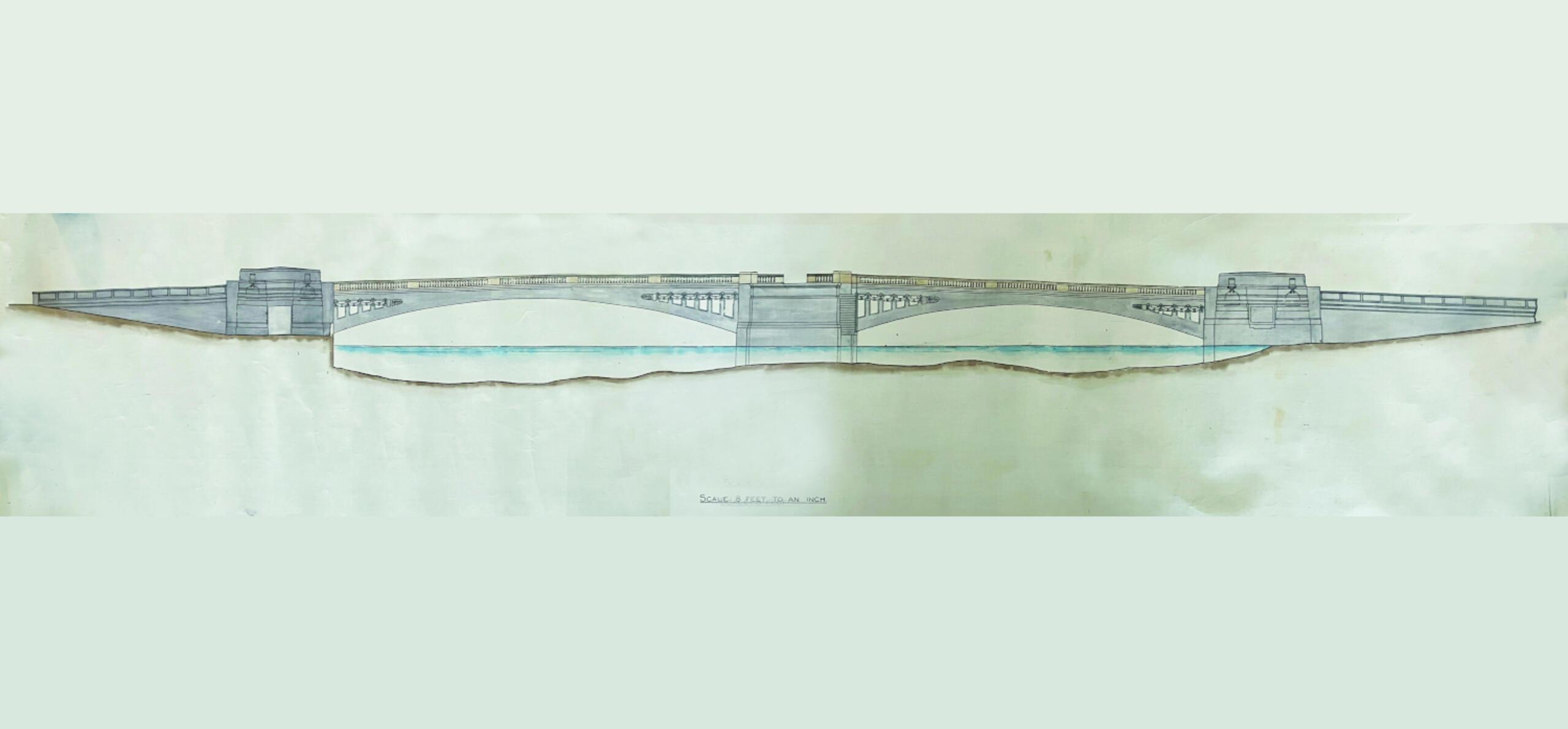
Header image: Drawing for the design of Caversham Bridge, seen from the east. Royal Berkshire Archives R/acc4447.55
In this guest blog Helen Lambert, President of Caversham and District Residents Association (CADRA), introduces the nine centuries of history of Caversham Bridge.
Caversham Bridge 1231 – 1869 – 1926 – 2026
This year marks the centenary of the ‘new’ Caversham Bridge, formally opened on 25 June 1926. But two bridges came before: the picturesque early bridge which was repaired and patched up over the centuries and the iron bridge which lasted less than 60 years.
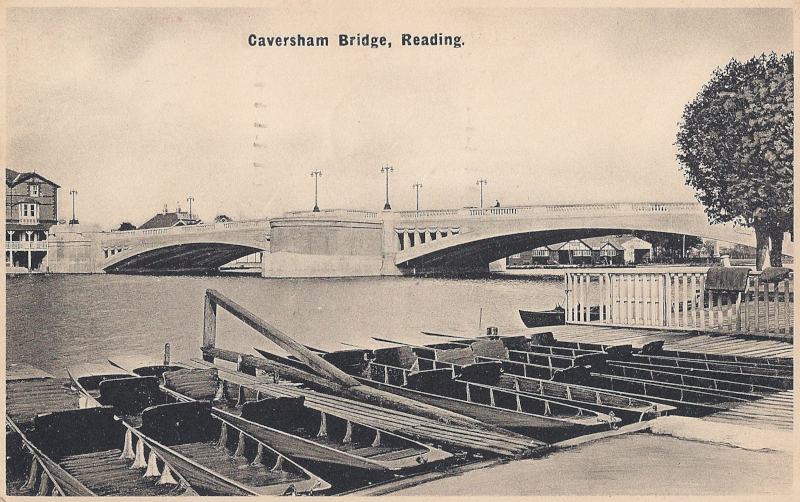
Old postcard showing Caversham Bridge and the later Caversham Bridge Hotel rebuilt in 1912. Courtesy of CADRA.
Early records
The first written reference to a bridge is dated 2 May 1231 and signed by Henry III, commanding the Sheriff of Oxfordshire to go to the chapel of St Anne on the bridge at Reading over the Thames one side of which is built on the fee of William Earl Marshal. William Marshal had risen from humble beginnings to become Regent to the young Henry III. He came home to die in his Manor of Caversham which had needed a link across the Thames to Reading Abbey. Along with the Shrine of Our Lady of Caversham, the chapel on the bridge was an important source of alms as well as a place to stop and pray for safe crossing.
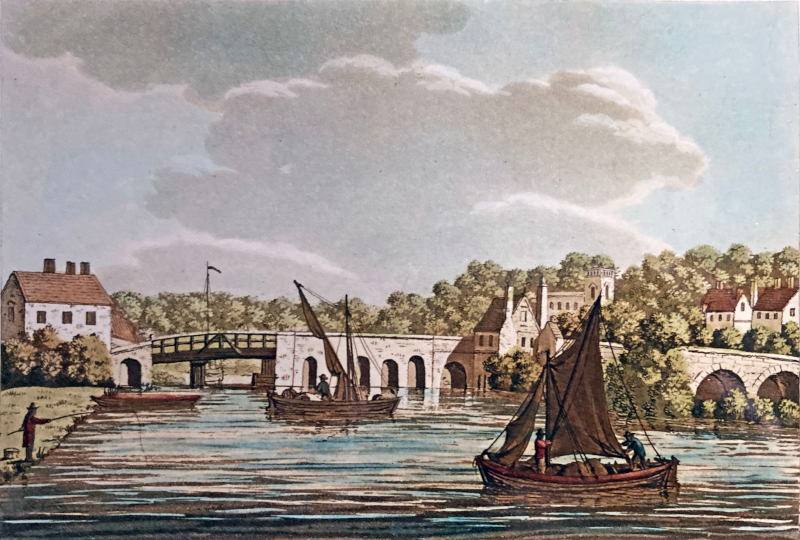
Painting of the early bridge by Samuel Ireland (1790). Courtesy of Reading Libraries
A place in English History
Over the centuries, the bridge at Caversham played its part in key moments of history. With the dissolution of the monasteries in 1538, Henry VIII took possession of the stone chapel. Sir William Knowles met Queen Elizabeth at the bridge and entertained her with many devices of singing, dancing and playing wenches and such like. In 1642, Charles I and his army intended to march over the bridge to Reading but a section had been removed by the Parliamentarians. The following year, when a Royalist relief force failed to relieve the siege of Reading, there was fierce fighting at the bridge and huge loss of life. In 1647, Charles I spent time at Caversham Park, where he saw his older children for the last time before crossing Caversham Bridge on his way to execution.
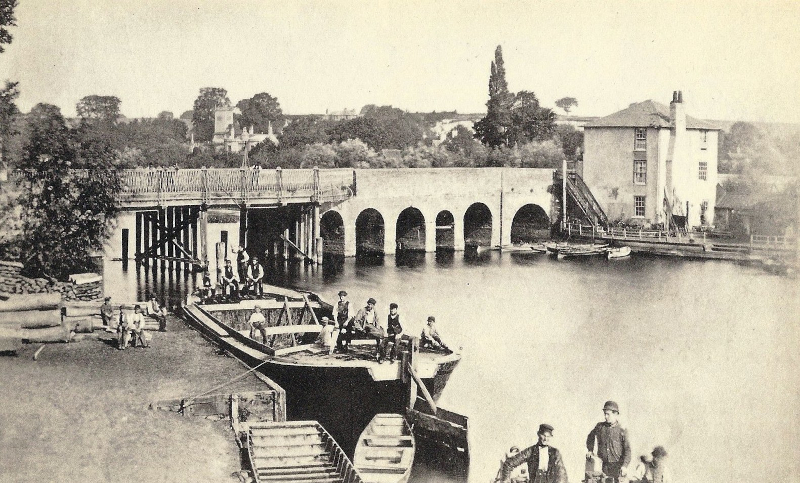
Old postcard showing barge building on the Reading bank, the wooden section on the Reading side, the stone arches on the Oxfordshire side and the Waterman’s cottage. Courtesy of CADRA
Split down the middle
The boundary between Reading and Oxfordshire lay down the middle of the Thames and so responsibility for the bridge was divided and a frequent source of conflict, particularly after alms to the chapel ceased. Following the Civil War the wooden section on the Reading side was reinstated.
Bridges were generally repaired not replaced and changes were made over the centuries. The earliest images of the bridge date from the 18th century and the picturesque views of the old bridge were popular with artists including J.M.W. Turner and local artist William Havell whose family lived on Bridge Street.
Only one vehicle could pass at a time with refuges for pedestrians to dodge out of the way and roads leading to the bridge on either side were inadequate. The stone arches on the Caversham side limited the size of boats which could pass through, though there was better clearance under the wooden section on the Reading side.
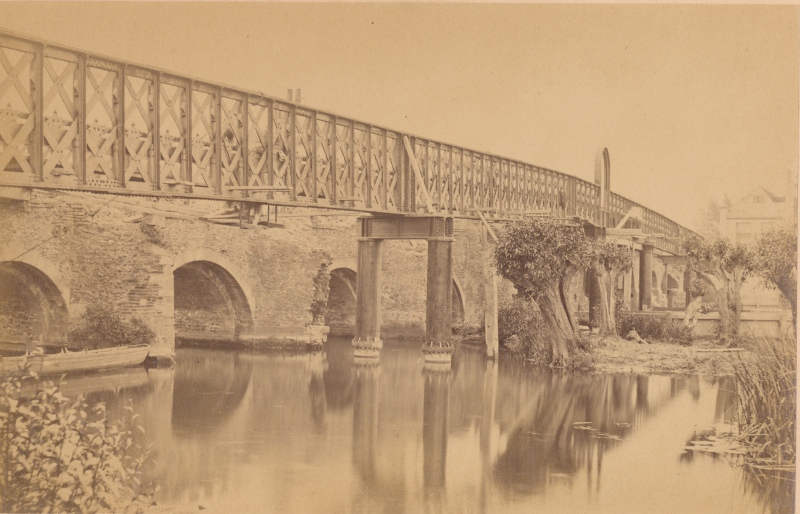
The iron bridge is constructed over the arches. Reading Museum, 1931.120.1
The Caversham Bridge Act 1868
Feudal duties to contribute to repairs of the Oxfordshire side were still in place and in 1813 the King brought an action against Earl Cadogan, a former owner of Caversham Park, for a nuisance in not repairing Caversham Bridge. Meanwhile the wooden structure on the Reading side was also in a dangerous condition and, in 1830, the section was rebuilt at a cost of £1534.
The Caversham Bridge Act 1868 empowered the Corporation of Reading to improve or rebuild the bridge and improve the roads for 152 yds on the Reading side and 86 yds north in Caversham. It included a list of offences which could result in a forfeit of up to 40 shillings.
The rebuilding costs would be split with Oxfordshire, whose share would be reduced by £700 from the owners of Caversham Park and other estates. The Act proved controversial with petitions submitted, maintaining that entire rebuilding is unfounded and that provisions in the bill were injurious to the inhabitants of Oxfordshire. Thames Conservators petitioned that the plans would interfere with navigation.
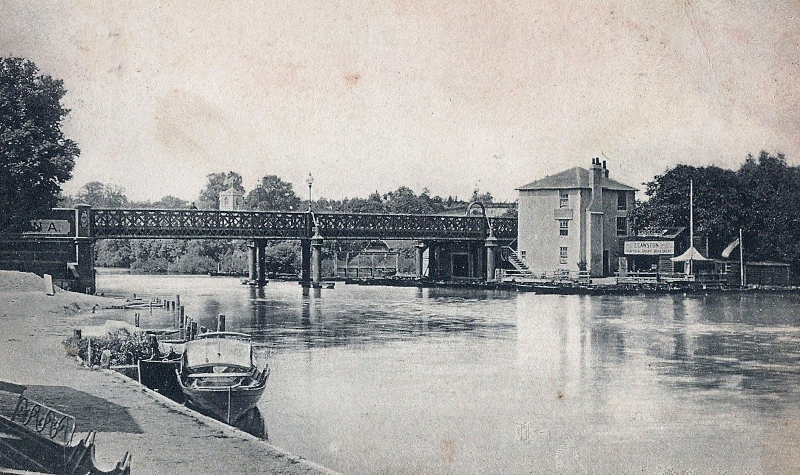
Old postcard showing the iron bridge completed. Under the right-hand section, it is just possible to see the frame for the eel bucks (baskets lowered into the river to catch eels.) Courtesy of CADRA
Completing the iron bridge 1868/69
The new structure was built in wrought and cast iron with lattice work girders initially constructed over the old stone arches, with pillars driven into the riverbed by a screw action, using a capstan. The flooring of the bridge was assembled with over 12,000 rivets. The new roadway was 20- foot wide with two footpaths each 5-foot wide.
The cottage on the site of the old chapel on the island would have impeded the wider iron bridge so, on 29 January 1869, the three-storey building – weighing 150 tons – was moved about 25 feet eastward by hydraulic and screw jacks.
Despite delays from flooding in the February, the bridge was completed within a year. It opened to traffic 24 July 1869 at a cost of £10,154 13s 9d. As new utilities were connected, the bridge could support the cables. A huge new gas main hung on the bridge apparently prompted a new coat of paint for the bridge. 1891 saw severe floods.
In 1904, new gas lights were added to the bridge and some repairs completed but the bridge was rapidly becoming inadequate for the rapid growth in the area.
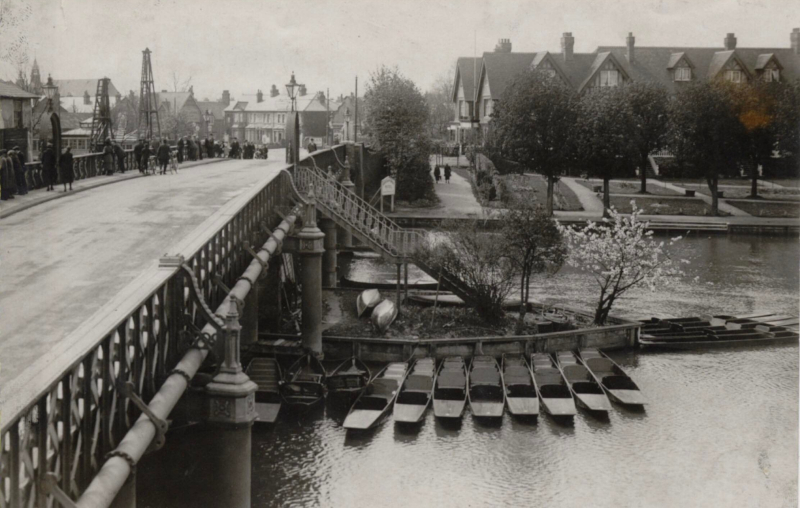
Old postcard showing the iron bridge with the new gas main attached. Top right the iron public conveniences built in 1906 can just be seen. Courtesy of CADRA
Enjoying the river
Better access to the river marked the beginning of a great boom in pleasure boating and local boat builders and hotels flourished. The tram service extended up to the Reading side of the bridge with its own cast iron public convenience to serve passengers. This is still in use at the Chiltern Open Air Museum, where it was moved in 1991.
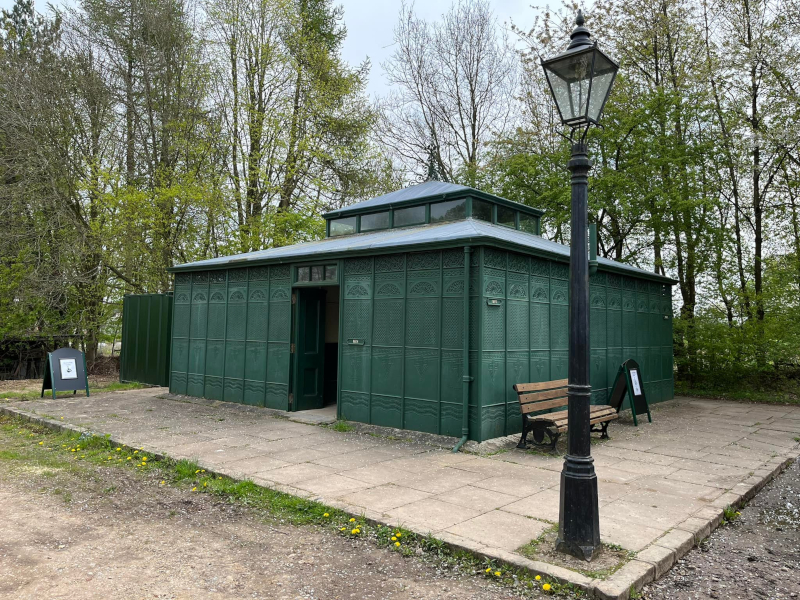
Photo of the public conveniences now at the Chiltern Open Air Museum – taken by Helen Lambert in 2023
The Reading Extension Order
The Reading Extension Order in 1911, bringing Caversham into Reading, provided for a new or wider bridge. Studies were completed in 1912, and it became clear that a new Caversham Bridge would be needed as a well as second new bridge. An option of a different line for the replacement bridge terminating on Church Street near the junction with Hemdean Road was rejected.
In December 2013, Mouchel & Partners, specialists in the new techniques of reinforced concrete, submitted their first report with design and cost for both bridges and work began to acquire land for the approach roads.
Both bridges were to be built using the Mouchel-Hennebique system of reinforced concrete. This method would support a long span with a flat curve providing headroom for navigation and preserving an approach defined by buildings close to Caversham Bridge.
You can read more of the detailed planning for the two new bridges in the blog Reading Bridge 1923-2023 or in the CADRA booklet Reading Bridge 1923-2023
Plans were drawn up to widen Church Road, Church Street and Bridge Street and 1914 saw multiple purchases of small plots with more completed in 1921. These included the frontage of Caversham House on Church Street where the tunnel had allowed pupils of the Academy to cross safely to the school playground, the site for Caversham Library.
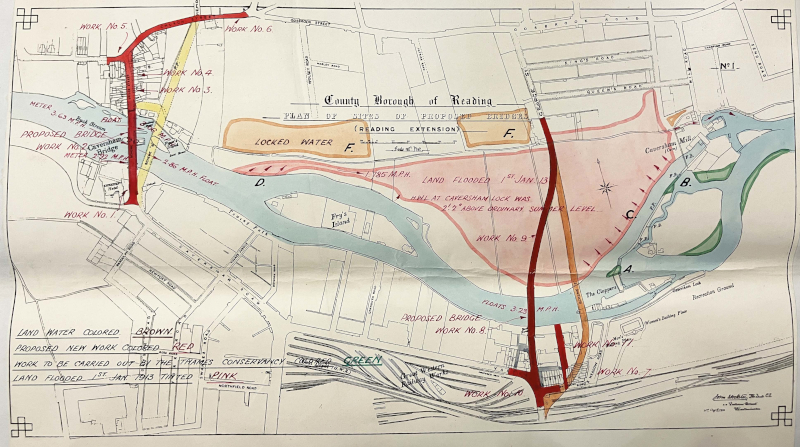
Plan showing different options for the two bridges. The line in yellow shows the bridge terminating on Church Road, near the junction with Hemdean Road. Royal Berkshire Archives, R/Box782
Detailed Design
Plans for the two bridges were halted with the outbreak of World War I in 1914. As the new Reading Bridge neared completion in 1923, plans for Caversham Bridge were being finalised. The engagement of the prominent architect Sir Henry Tanner for the general design of the new Caversham Bridge reflected its significance and long history. Sir Henry was well known for his use of reinforced concrete in public buildings and had been President of the Concrete Institute.
Mouchel produced a model based on Sir Henry’s design, which used setbacks – stepped recessions – to relieve and break up the mass effect of the concrete abutments. Semi-circular promenade bays on either side of the bridge, stepped down from the carriageway and surrounded by a concrete balustrade, would afford fine views of the river. The parapets would be built of Aberdeen granite.
Eight double bronze lampstands would be produced by the highly regarded Bromsgrove Guild of Applied Arts, who specialised in traditional skills, at a cost of £1425. The Guild had been awarded a Royal Warrant in 1909 for the main gates to Buckingham Palace, and in 1911 they had produced the Liver Birds which topped the Royal Liver Building in Liverpool. This was a very early example of a building constructed in reinforced concrete, also built by Mouchel. Caversham Bridge was to be in exalted company!
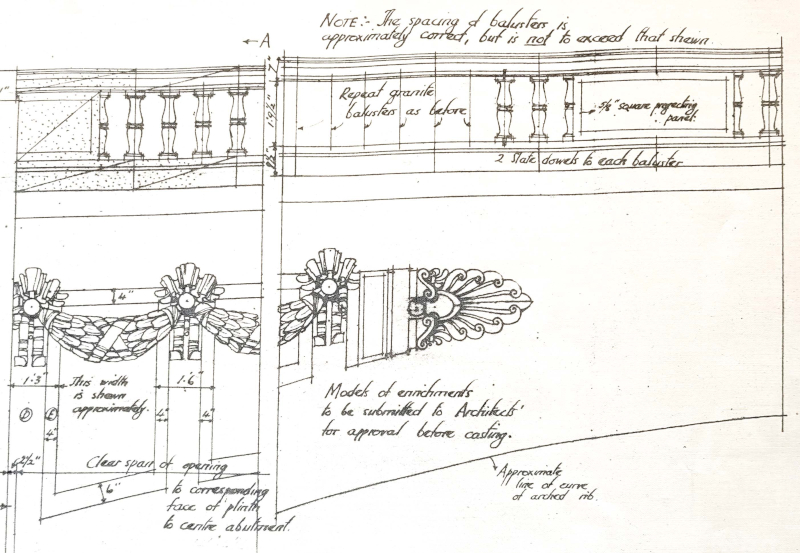
Mouchel produced detailed drawings of the moulded concrete ornamentation. Royal Berkshire Archives, R/acc4447.55
Work begins
In October 1923, the provisional cost for Caversham Bridge was £74,500 and the Ministry of Transport agreed a grant of 50%. Work started on 13 March 1924 with the construction of a 6-foot-wide footbridge and the transfer of gas, water and electricity mains. The Waterman’s Cottage was removed to make space for the eastern central abutment.
During the excavations, workers discovered the masonry foundation of the old chapel, joined to the arches of the old bridge. It was photographed and recorded before its removal, stone by stone.
A total of 12,000 tons material was excavated for the abutments, but the chalk found during the process turned out to be of poor quality, so the foundations had to be deeper than expected: 11,200 tons of concrete were placed, supplemented by 11m (35’) long driven piles.
Steel sheet piles were invented between 1902 and 1906, so the two bridges were ‘cutting edge’ structures using the latest techniques.
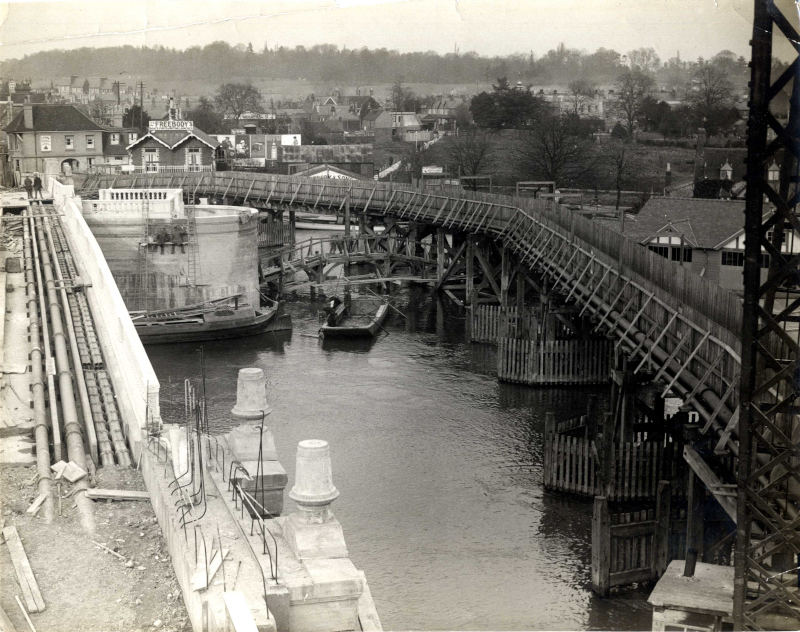
To the right is the temporary footbridge. Below it can be seen the new bridge to Pipers Island and some of the barges used during construction. Ducts for utilities are being laid on the new bridge. Courtesy of Reading Libraries.
Islands in the River
Several small islands were removed over a period, first those on the west to improve navigation and reduce flooding, then more were cut away to accommodate the new bridge. This separated the island now known as Pipers Island and permission was granted to construct and maintain a footbridge, for as long as the island was used for boat letting.
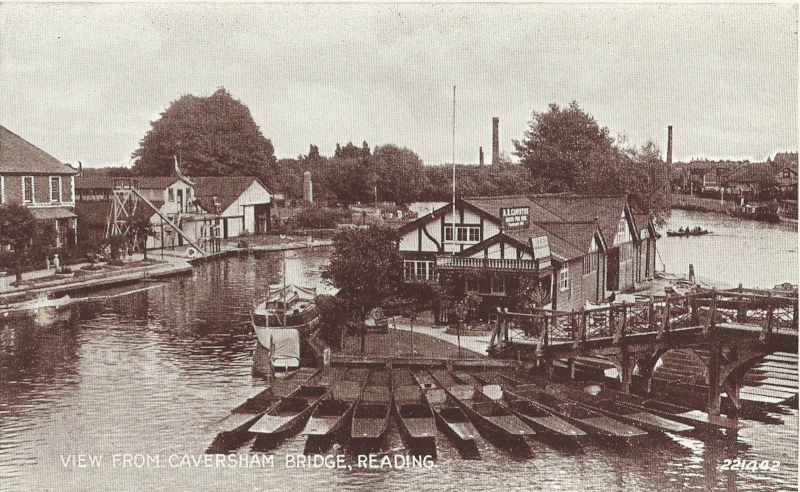
Old postcard showing Cawston’s premises on Piper’s Island. On the main bank is Freebody’s Lido. Courtesy of CADRA
A royal opening
As the bridge neared completion, pedestrians were allowed on to the eastern side. In April 1926, work started to remove the temporary footbridge but plans for a formal opening on 12 May had to be postponed because of the general strike that week.
The bridge opened to traffic on 8 May, and on 25 June the Prince of Wales spent a full day visiting Reading. He walked across Caversham Bridge to unveil the plaque before travelling on by barge to Reading Bridge. A.L. Humphreys, a well-known author and publisher, and a good friend of Oscar Wilde, wrote the souvenir booklet saying: In a pageant of Caversham the historic bridge would of necessity play a chief part; in a pageant of the whole nation’s history, it would well deserve a place.
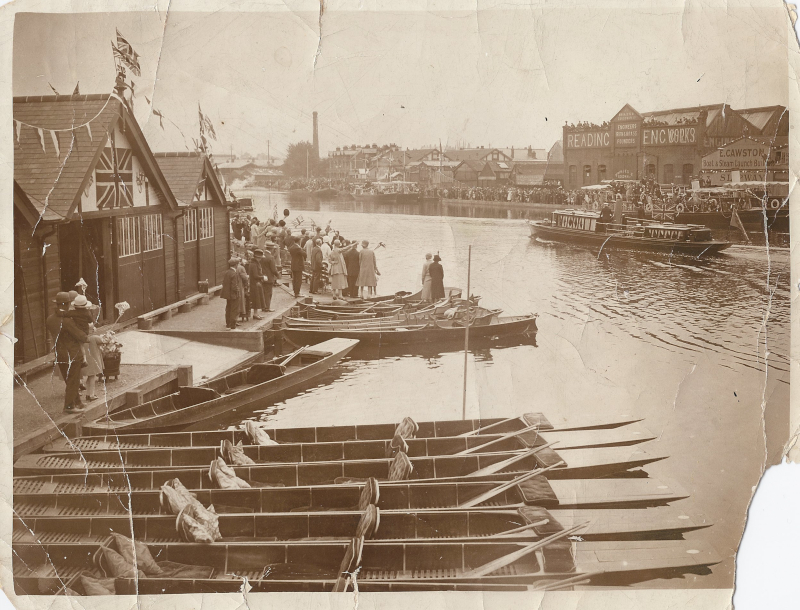
Crowds gather on the Reading bank and Piper’s Island to watch the royal visit. Papers of the late Mary Kift/CADRA
A final handover
The Borough Extension Committee, which had supervised the work for both Reading and Caversham Bridge, met for the last time on 12 October 1926. At the meeting, the contractor Holloway Bros Ltd submitted their final report: the bridge had cost a total of £70,649 5s 5d, just £18 over budget. Construction was completed in 25 months, five months over plan due to the additional work on the foundations and the suspension of construction due to flooding.
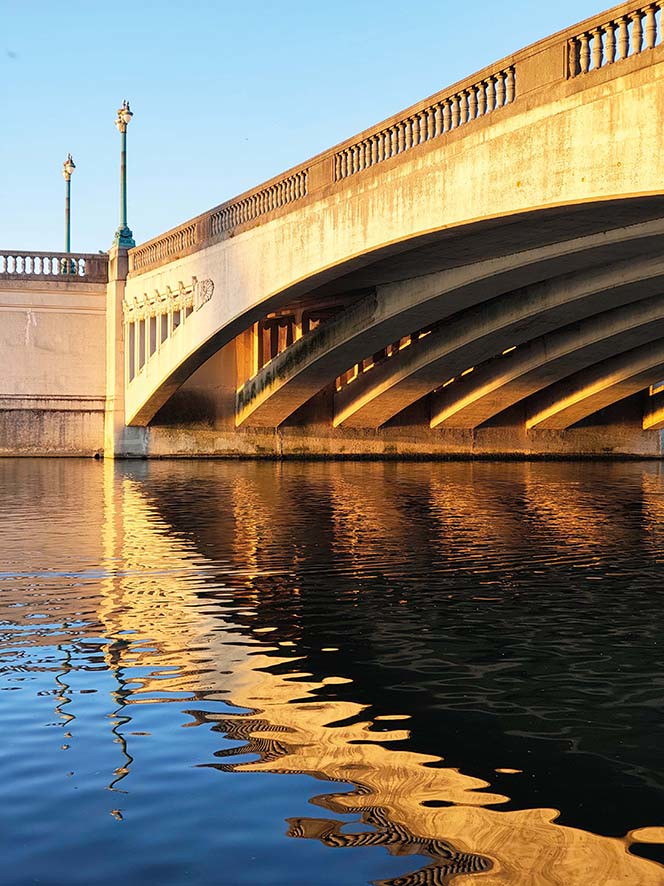
Photo showing the six ribs forming the river arches, the concrete ornamentation, the granite parapets and the lampstands produced by the Bromsgrove Guild of Applied Arts - taken in 2026 by Anke Ueberberg
Find out more ...
You can find more images and more detail in the booklet developed for the centenary published by the Caversham and District Residents Association (CADRA). This is available to buy, with the companion booklet for the Reading Bridge centenary, in both the Reading Museum Shop and Fourbears Bookshop in Caversham.
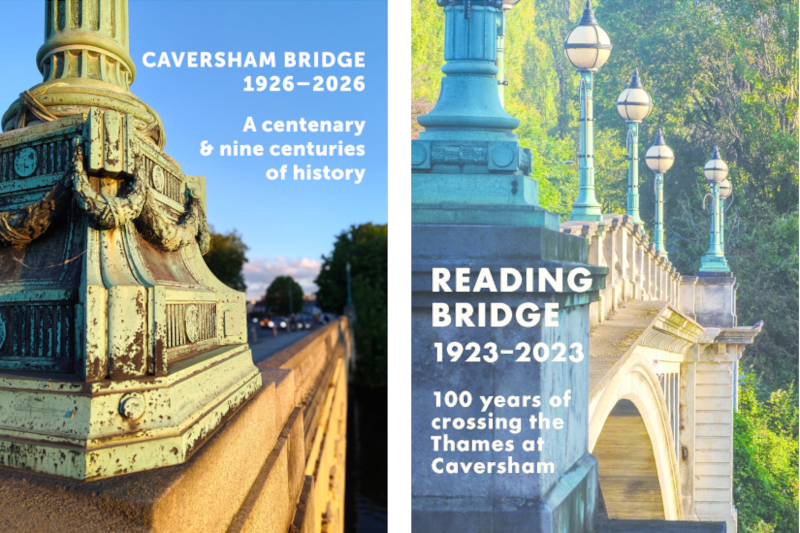
The companion booklets for Caversham Bridge and Reading Bridge centenaries
See our other sources
Royal Berkshire Archives: Plans and documents including Minutes of the Borough Extension Committee and Works, Navigation and Regulation of Water Committee minutes, 1917-1926
Royal Berkshire Archives: Our River Thames (exhibition)
Reading Borough Council: St Peters Conservation Area Appraisal (November 2018)
Newspapers
‘Happy Wanderer’ articles, Caversham Bridge (no date)
‘The day a prince came to open town bridge’, Reading Chronicle (27 November 2014)
Online sources
Bromsgrove Guild of Applied Arts, Wikipedia (no date)
'Bromsgrove Guild’, Glasgow City of Sculpture, Gary Nisbet (no date)
Reading University Boat Club: Our History (no date)
Henry Tanner (architect), Wikipedia (no date)
‘1926 Prince of Wales’, Simonds Family (no date)
Publications
Reading Bridge 1923-2023: 100 years of crossing the Thames at Caversham by Caversham and District Residents Association (CADRA) (2023)
Down by the River: The Thames and Kennet in Reading by Gillian Clarke (2009)
No Distinction Of Sex?: Women in British Universities 1870-1939 (Women's and Gender History) by Carol Dyhouse (1995)
Caversham Bridge 1231-1926 (souvenir programme) by A.L. Humphreys F.S.A. (1926)
Life in Old Caversham by Mary Kift (2004)
Four Berkshire Bridges: Two pairs of reinforced concrete bridges over the middle Thames by Edwin A.R. Trout (2020)
A Reading Bookseller, Publisher and Author: A biography of sorts of Arthur Lee Humphreys (1865-1946) by Evelyn Williams (2018)