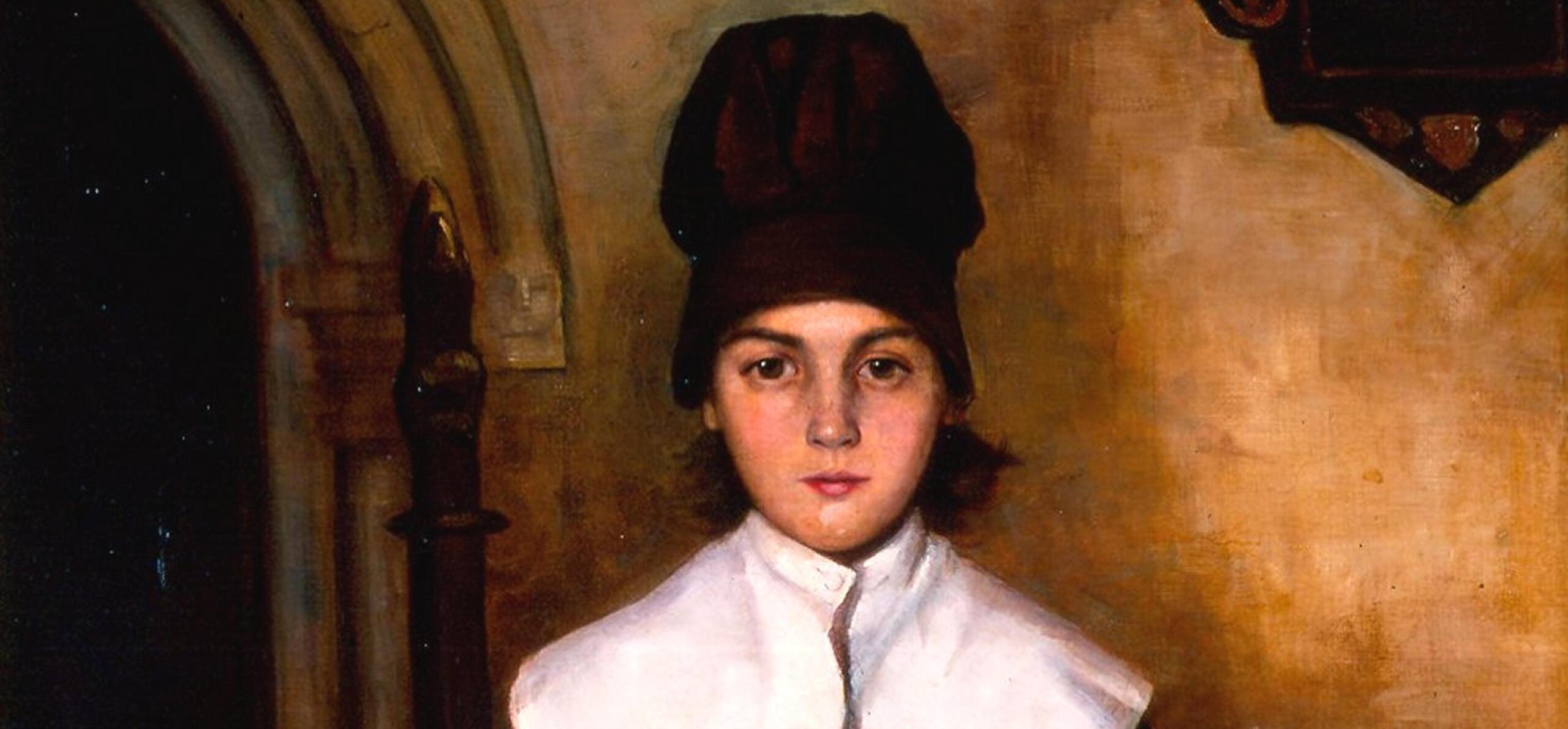
There is a fascinating portrait in the Story of Reading Gallery. It is a painting of a pupil from the Green Girls School. Read about the history of the school, the identity of the sitter, and other museum artefacts associated with the school.
Who were the Green Girls?
Reading’s Green Girls School was founded in 1782 and named from the colour of the girl's dresses. It was a charity boarding school that gave its working-class pupils a basic education but was mainly dedicated to producing young women who were trained in various household skills and would make good domestic servants. Domestic service was the most common form of employment for working class girls in Reading during the nineteenth century. Before 1800 there was little educational provision for Reading’s poor children with only a small number attending charity schools such as the Blue Coat School for boys and the Green Girls School.
The school began in a cottage near St Mary’s Butts and in 1790, was moved to a substantial building on the north side of Broad Street, where it remained until the 1880s. It moved to Russell Street in 1884 and finally closed in 1922.
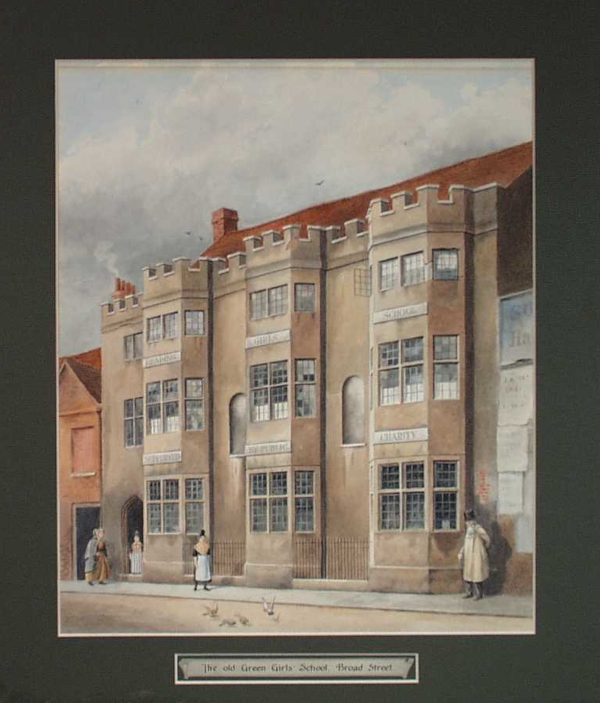
Watercolour of the Old Green Girls School, Broad Street, Reading by Herbert Beecroft; signed and dated 1899. Museum object number 1982.85.1.
The school was founded by the vicars of Reading’s three ancient parishes: the Hon William Cadogan of St Giles, Charles Sturgess of St Mary’s and Dr John Nicholls of St Laurence and other evangelical supporters. The pupils had to be born in one of Reading’s three parishes. They first entered aged between ten and twelve-and-a-half and left the school aged fifteen years old going into work or an apprenticeship. Initially only six girls attended, but by 1884 they had 24 pupils on the roll.
The pupils were taught to read and write, basic housework, cooking, washing, ironing, sewing and religious knowledge. As the century wore on more found work in factories such as Huntley & Palmers. During the twentieth century office work became another option. Such social changes brought about the school's closure in the 1920s.
Painting of a Green Girl
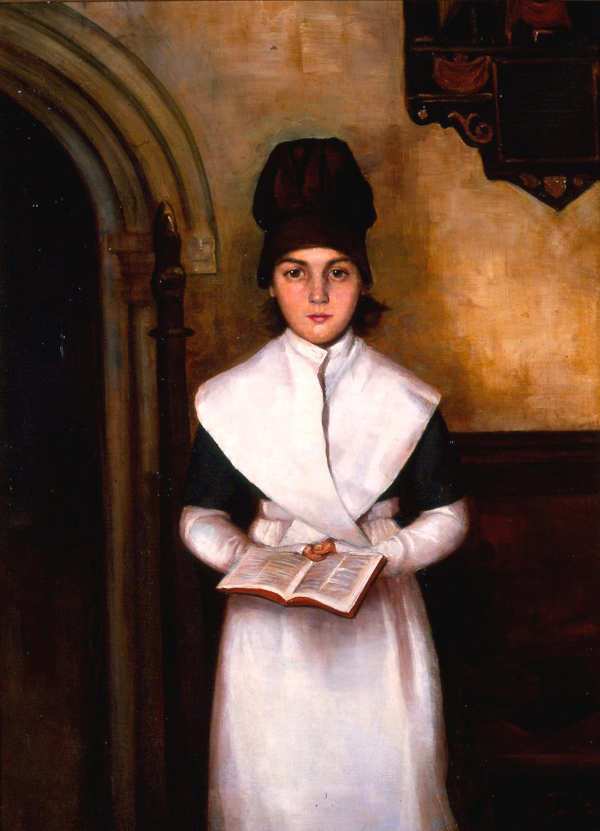
A Pupil of Green Girls' School, Reading, by Annie M Bradley (1863-1941), signed and dated 1892. Museum object number 1946.94.1.
The portrait shows a young girl wearing the school uniform: a dark green dress covered with a white apron, large white collar, white fingerless mittens, a large bonnet, and is holding a book. The interior is the northside of the chancel at St Mary the Virgin Reading, in front of the entrance to the Vestry and John Kendrick's monument.
This portrait was painted by Annie Margaret Bradley (1863-1941), who studied at Reading School of Art and was a dedicated member of the Reading Guild of Artists (RGA). She served continuously on the RGA Council for the first eight years of the Guild's existence, was vice-president from 1939-1941, and RGA council meetings were regularly held at her home. It was reported in the Evening Gazette November 12th 1935 “Another outstanding picture among the oils is Green Girl in St. Mary's Church Reading by Miss Annie M. Bradley, also of Reading. I do not understand the title as perhaps I ought but admire tremendously the calm lovely grace and rich parchment tone of the drapings. The picture has a companion Reading's Green Girl at Work and here again a lovely figure set in lovely shades”. We don’t know where this second painting is? Is it still local?
The identity of the pupil in this painting was lost. But thanks to searching online digital newspaper records Dr Rhi Smith of the University of Reading has found her name.
The mystery solved
The pupil in the portrait is Annie Bessie Searle, married name Godfrey (1879-1969). Her husband, Ernest Godfrey, wrote to the Reading Standard in 1960 in response to a school photograph of the Green Girls. He wrote that his wife was a Green Girl who appeared in the photograph and was also “painted by a lady living in the Bath Road”. In a later issue Eleanor May Skrimshire, Annie Bradley’s niece, responded saying it was her aunt’s painting that is now in Reading Museum.
Annie Searle was born in Reading, and her family lived at Finch Court and Finch Street. These old weaver's cottages near Hosier Street were demolished during the construction of the Inner Distribution Road. Her parents Cecilia Searle and Jacob Searle, biscuit baker in Huntley and Palmers, were both born in Reading. By 1901 Annie was working as a housemaid for a Stockbroker in Kensington, London. She married Ernest in 1909, and they celebrated their Golden Wedding Anniversary in 1959.
Annie was 12 or 13 years old when this painting was created.
Photograph of a Green Girl
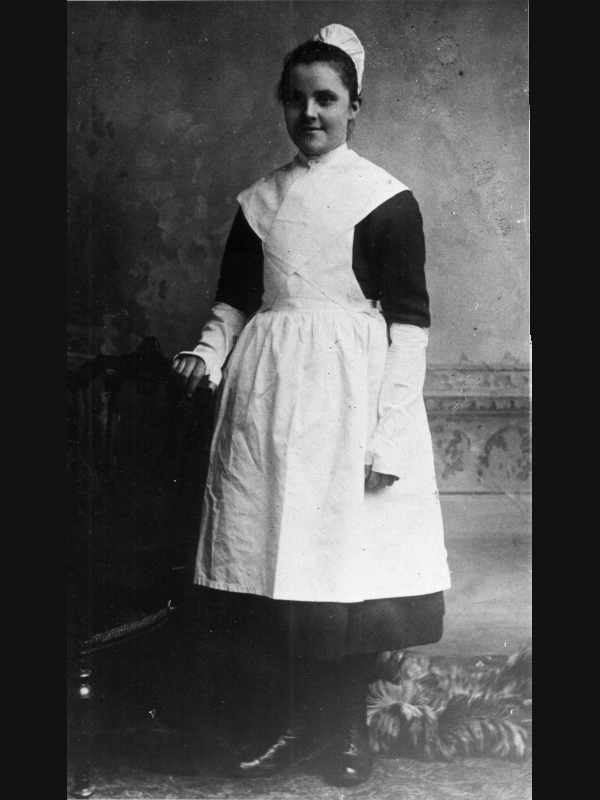
Photograph of Green Girls School pupil, Reading in 1907. Museum object number 1949.206.7.
This photograph shows Miss Elsie Nellie Watson, who was a pupil at the Green Girls School between 1903 and 1907. It was taken when she was sixteen. The uniform barely changed throughout the 140-year history of the school.
Needlework samplers
The Museum also has a few needlework samplers created by Green Girl pupils. Embroidery samplers were created as an exercise or demonstration of skill in needlework. Needlework was an important part of the students’ education, and a skill required in domestic service. Samplers regularly include the alphabet and the name and date of the maker.
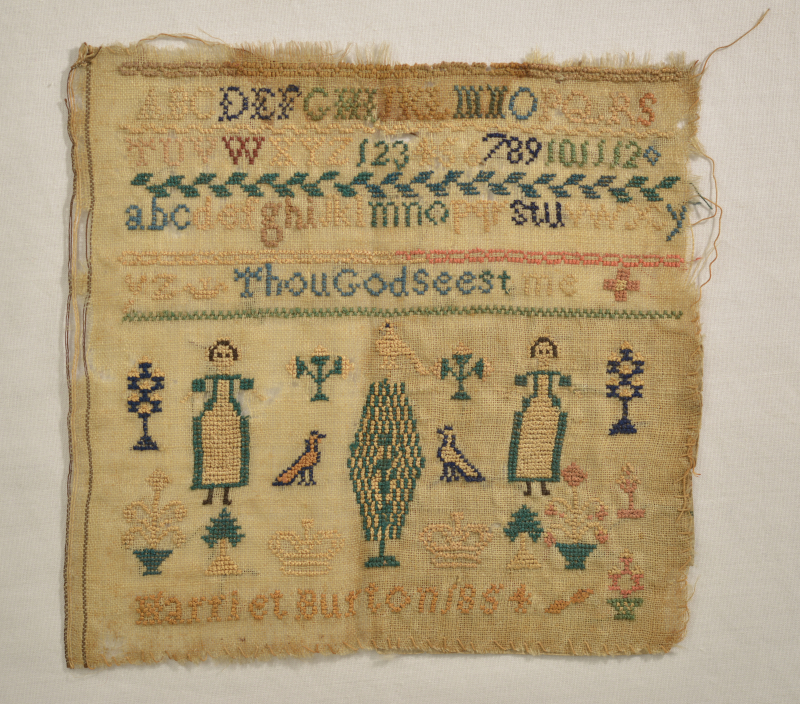
Sampler by Harriet Burton, 1854. Museum object number 1958.147.1.
This small sampler was made by Harriet Burton at the Green Girls' School, Reading. Her design includes two girls in their distinctive uniform of green dresses and white aprons.
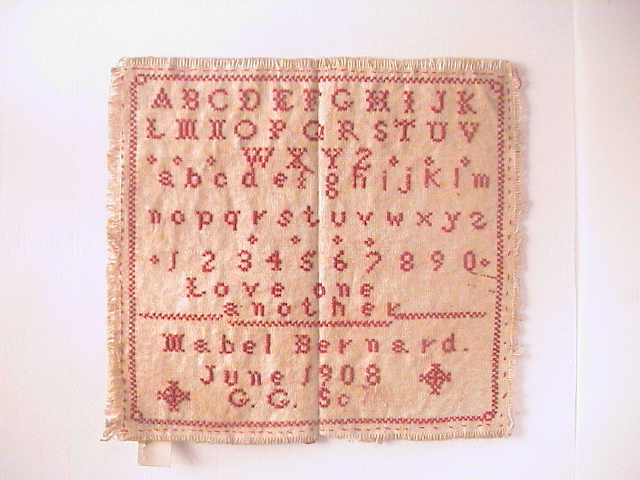
Sampler by Mabel Bernard, 1908. Museum object number 1958.147.2.
This small sampler with red cotton needlework was made by Mabel Bernard at the Green Girls' School, Reading. The backing is a page from a school exercise book with a handwritten geography lesson!
Thanks to Rhi Smith for sharing her research into the painting ‘A Pupil of Green Girls' School, Reading’ by Annie M Bradley.