Saturday 13 June to Saturday 22 August 2026
Venue: Welcome Gallery Reading Museum
Price:
Free, drop in
What:
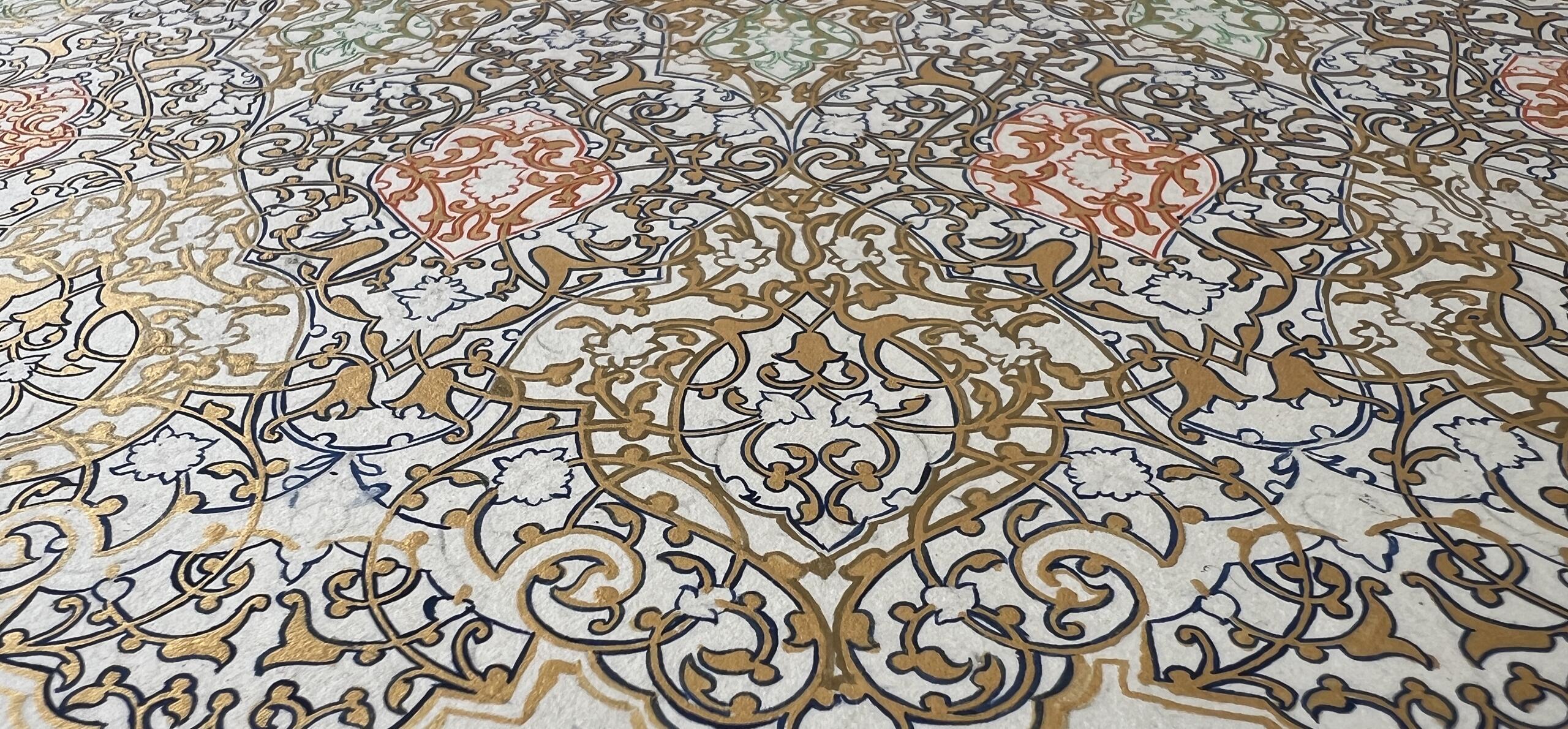
Artist Fakhria Nezami combined elements from many sources in Afghanistan to create this original artwork, now on display in the Welcome Gallery. It is a remarkably large Shamsa design using the refined techniques of traditional miniature painting and took over five months to paint. Its creation was a meticulous process, the paper was made by hand in Afghanistan and, where possible, the artist made the paints to traditional recipes. Its painting required time, concentration and great skill.
A Shamsa is a traditional motif in Islamic art, often found on the opening page of illuminated manuscripts but also on carpets and architectural interiors. It suggests a sunburst with its radiating layout. The intricate, repeated designs of arabesques and floral elements are an expression of a harmonious universe emanating from a single creator.
Fakhria added the diamond-cut lapis lazuli stone as a shining centre to the design, knowing that lapis lazuli is in the hearts of all Afghan people. It is inextricably linked to their economy and culture. The best quality lapis lazuli in the world comes from high in the mountains of north-east Afghanistan where it has been mined for over 6000 years. Difficult to extract, it has been prized for the rare blue of the stone and for the pure blue pigment, ultramarine, that can be extracted from it. In all cultures it has precious, otherworldly, connotations. In Islamic art it is also seen as protective and lucky, the colour of royalty.
Fakhria Nezami is an artist from Afghanistan specialising in calligraphy, miniature painting and illumination. Her practice is rooted in the artistic traditions of Khorasan and the Herat school. She studied and taught at the Turquoise Mountain Institute in Kabul as well as Kabul University and established a thriving studio producing traditional arts while supporting emerging artists. She is currently based in the United Kingdom. Her work seeks to connect cultural heritage with contemporary artistic expression, reinterpreting traditional forms through modern design.
Detail shows artwork in progress