In this guest blog Martina Margetts explores Reading Museum’s important new art commission by metalsmith Adi Toch. This is a Contemporary Art Society commission supported by the Griffin Fund and enhanced by the Reading Foundation for Art.
This beautifully complements the Museum's Roman Britain Reimagined in Reading project that will refresh the Museum's Roman Silchester Gallery to tell new stories about the town of Calleva, based on the most recent archaeological research by the University of Reading, while enhancing the display of the Museum's important Silchester Collection. The project is supported by the National Lottery Heritage Fund.
Two defining capacities of being human are imagination and interpretation. The work of artists and archaeologists demonstrate these every day and underlie Reading Museum’s important new commission by the renowned metalsmith Adi Toch. In applying these capacities, presence is conjured from absence: the archaeologist digs speculatively through layers of the often disregarded ground beneath our feet, discovering the past through its material remains, while the artist connects concept with material and its formation. Each enriches our daily lived experience. This blog explores both the context and the commission, teamwork which has enabled an artist to contribute something original to the appreciation of our world.
The archaeological site
Silchester near Reading, 80 kilometres from London, is the site of the Iron Age settlement called Calleva Atrebatum, invaded in AD 44 by the Romans. It became renowned, especially because it was on the major east-west trading and transport route from London. The site is now owned by English Heritage and appears as grassy fields circumvented by the remains of Calleva Atrebatumn’s defensive walls and an amphitheatre at their edge. Exploring the whole site today, only imagination can conjure its originally prosperous community, with farming and trades, a military presence, temples and fine houses. It is thought that the town waned by the early 5th century, perhaps due to a decline in the water supply or the new Anglo-Saxon rulers enforcing abandonment.
A great legacy is that Reading Museum contains thousands of the site’s artefacts. The book, Silchester Revealed: the Iron Age and Roman Town of Calleva (2021), by Mike Fulford, Professor of Archaeology at Reading University, details the waves of excavation of the site since the Society of Antiquaries first sponsored digging in 1893. In Fulford’s own decades of research, leading teams of experts and volunteers at the site, he has traced the life of the Roman occupation of the town across 500 years. A core question defined his purpose: “what might we learn of the changing accommodation, diet, dress, environment, identity, occupations, past times and ritual behaviour of the inhabitants’’, discoveries which have “revolutionised our understanding of the town”. This revolution in understanding is underpinned by the site’s materiality - the main attraction for the Romans, who were keen to mine its mineral resources, and a core fascination for the artist Adi Toch.

Adi Toch (right) installing her new work in Reading Museum's Art Gallery
The artist’s commission
Objects are never neutral or insignificant. In both their appearance and usage they encapsulate socio-cultural, geo-political and economic features of life. When Adi Toch was first invited to consider a creative response to the Silchester site and its artefacts in Reading Museum, she naturally cleaved to her area of specialist knowledge. Within the collection Toch saw all the metal resonances of daily life, whether luxurious or humble, including weapons, brooches and fine gold rings, keys, cauldron chains, tools, hobnails from boots and hoards of copper alloy coins. However, with an artist’s eye for a narrative object, it was the story of the Ogham Stone which became the focus for her creativity.
In the early 5th century in Silchester, a decorative sandstone column from a verandah balustrade - now known as the Ogham Stone due to its surface inscription in Ogham, an ancient Irish language - fell into a garden well and crushed a pewter flagon. For Toch as an artist, the changed states of tangible vestiges of Silchester life led her to consider metamorphosis and memory through material and making. What impressed her was the idea of the accident: the stone and flagon’s fates entangled in the well and then her own serendipitous discovery of their connection when she saw them in Reading Museum.
The poetic forms of her objects arrest the senses by their material and formal contrasts: shiny and matt, off-balance yet poised, juxtaposing soft pewter with hard flint, sandstone or cassiterite. They have a surreal, uncanny, even subversive presence, because they evince the visceral violence of the Ogham Stone crushing the flagon. And yet there is gentle humour and poignancy: their scale invites intimacy, reflecting the warmth of a body as between parent and child. They generate discussion about how we perceive perfection and harmony, how we ourselves ‘function’ and experience difference, how we process memories. Given the collective title, By Association, the interrelationship of the group of objects renders them social objects, vulnerable yet resolute and questioning. The interconnecting forms within each object and as a group also echo the overall sociability of such a project, with its many experts pooling their knowledge and perspectives. Visitors’ engagement expands the dynamism inherent in the commission and the context.
A significant theme may be identified as that of belonging. The Romans invaded Britain, the Ogham Stone ‘invaded’ the pewter flagon, one part of each of Toch’s objects ‘invades’ another. In each case, one social group or object or event or culture butts against another, reinforcing the interdependence of peoples, things and terrain in our world. These ‘invasions’ can be sudden and adversarial or seeking reconciliation and collaboration. Toch’s stance, embodied in her ambivalent and ambiguous objects, is to engage empathetically and foster dialogue.
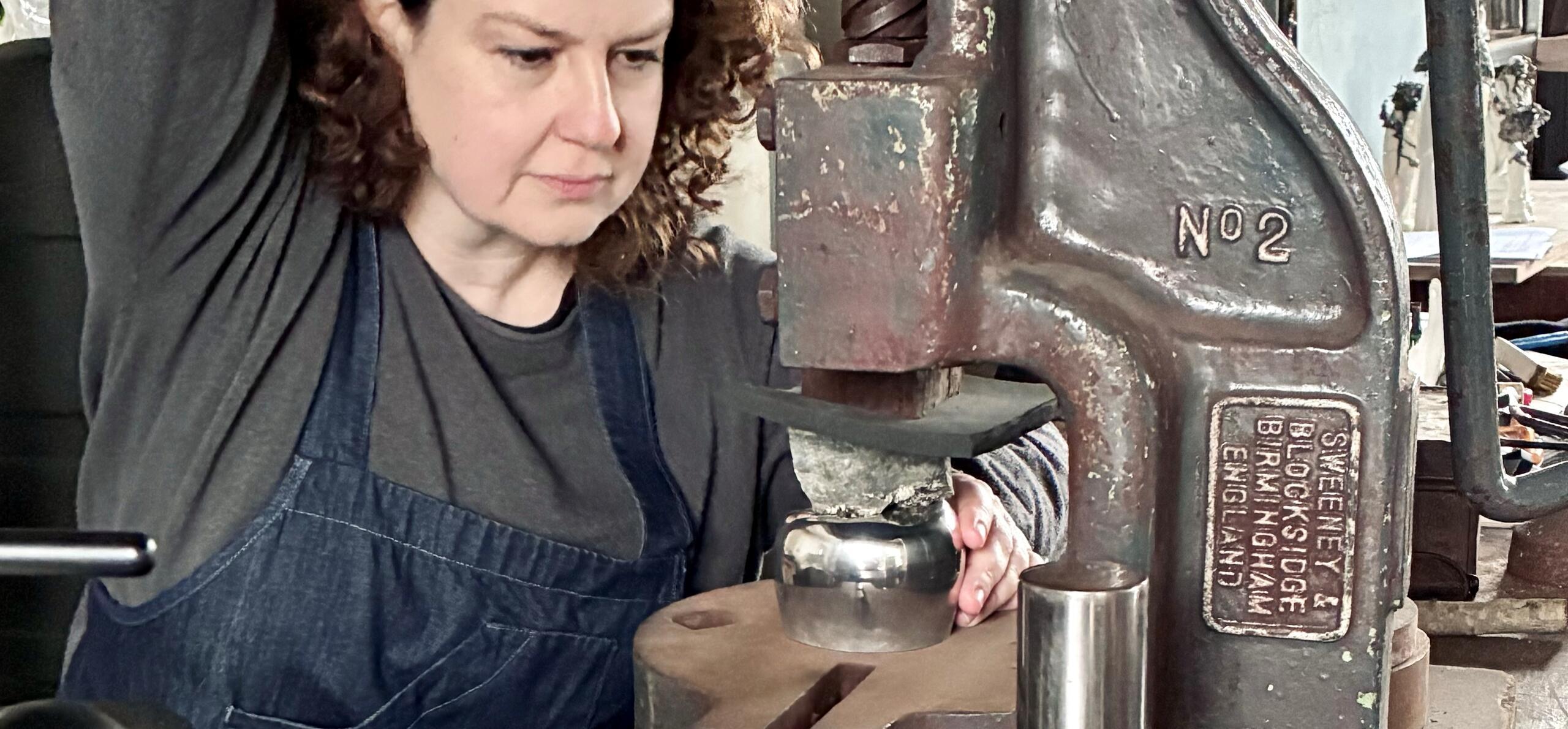
Although Toch’s concept of the commission was triggered by the two ‘accidents’ described above, the making is hard-won, the result of dedicated research and experiment with materials and processes. The patient testing, repetitious cutting, hammering and polishing of metal are highly skilled and time-consuming, but Toch’s expertise is manifested also in the decisive moment, as in when to stop the fly press as it depresses a form or when a mould to cast metal is sufficiently shaped.
The presence of metal traces, such as iron in the stonework of Silchester and the Romans’ extensive use of metal, including tin smelted from cassiterite, inspired a visit by the artist to Cornwall, the original site of tin-mining in England. Able to experience a tin mine from within, descending deep underground, Toch could enhance her understanding of time, a key dimension of the commission: the linear time of daily life in conjunction with the circular time of history in the present, with dreamtime and with the recurring emotions of memory. Objects have their own lives: when people have gone, materials and things remain to tell the story. Let us hope By Association can resonate in Reading Museum for centuries to come.

One of the objects that form 'By Association' by Adi Toch (image credit Sylvain Deleu)
Martina Margetts is a writer on visual arts and material culture, former Editor of Crafts and Senior Tutor in Critical & Historical Studies at the Royal College of Art.