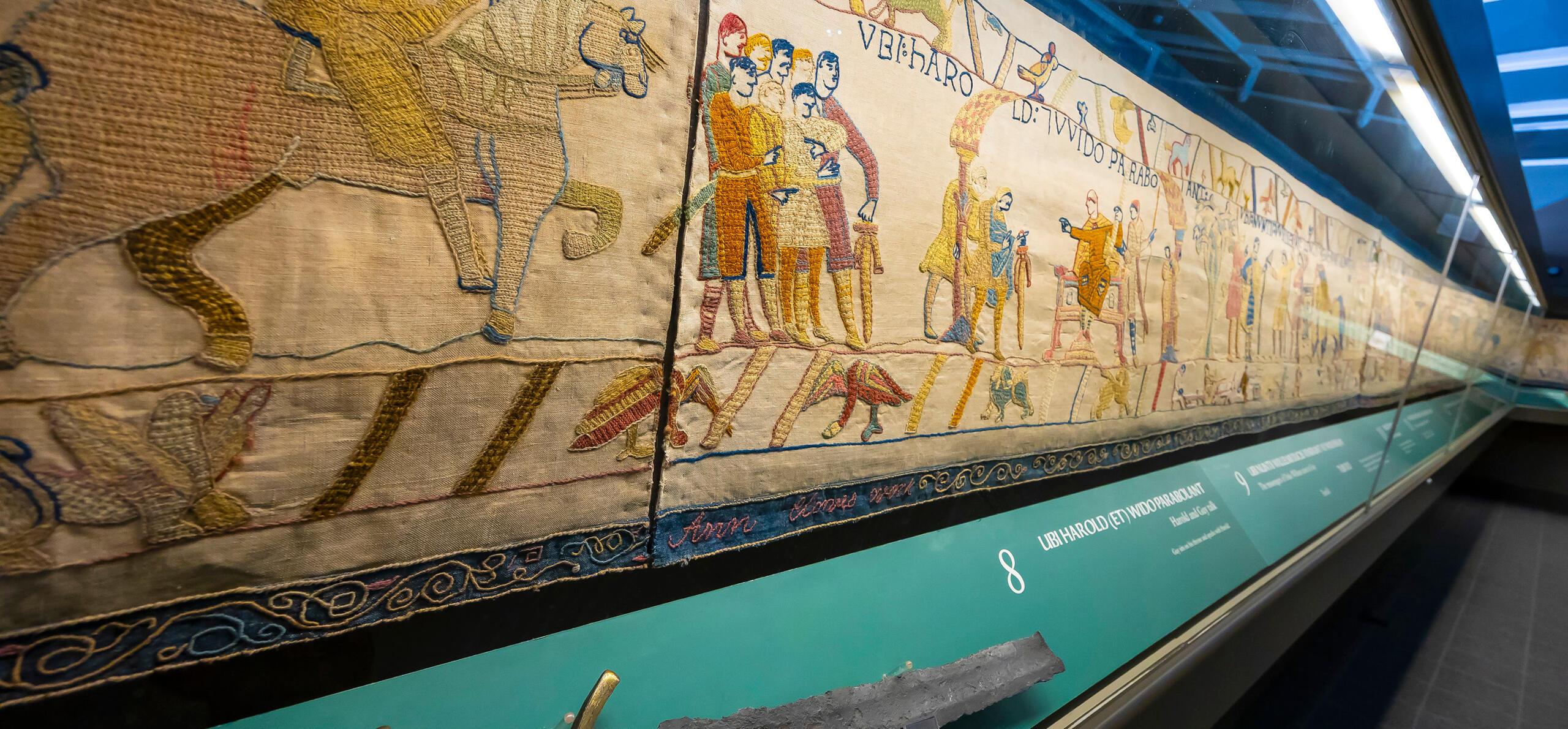
Reading’s Bayeux Tapestry is a full-size copy of the original 11th century tapestry. It was created in 1885-1886 by 35 women of the Leek Embroidery Society 'so that England should have a copy of its own'. Reading's tapestry toured the world, helping to make the Bayeux Tapestry and the story of 1066 famous.
The women went to great efforts to make this tapestry as accurate as possible - but there are some differences. This is not surprising as the embroiderers were working from hand-annotated tracings of hand-coloured photographs at the South Kensington Museum (now the Victoria & Albert Museum).
In this short blog we look at the main difference between the Reading’s tapestry and the original tapestry.
Spot the difference!
In places the Reading tapestry reproduces colours from the South Kensington Museum hand-coloured photographs which have since faded on the original Bayeux Tapestry. So, the Reading tapestry is often closer to the 11th century appearance.
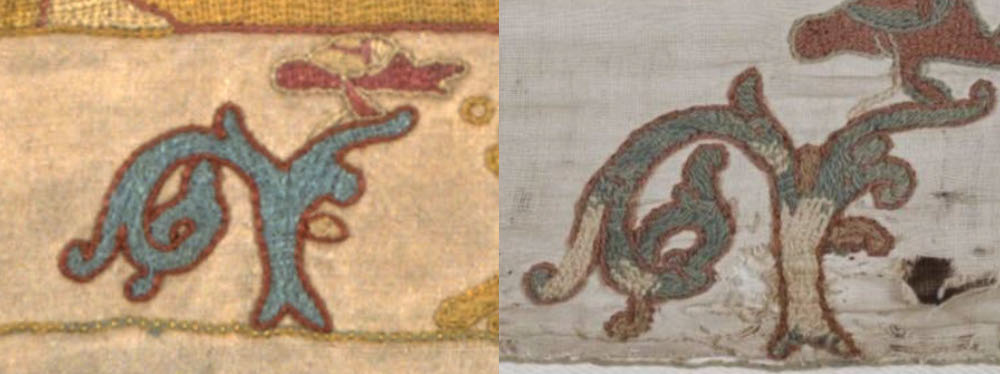
The Reading Tapestry (left) shows this tree’s original blue appearance. Today, the original tree appears green with a restored area in white (Ville de Bayeux, DRAC Normandie, Université de Caen Normandie, CNRS, Ensicaen, Clichés : 2017)
There is more yellow stitching on the Reading tapestry than the original, especially on animals. Did the embroiderers mis-read the written colour annotations on their tracings or did they have more yellow threads? We will never know!
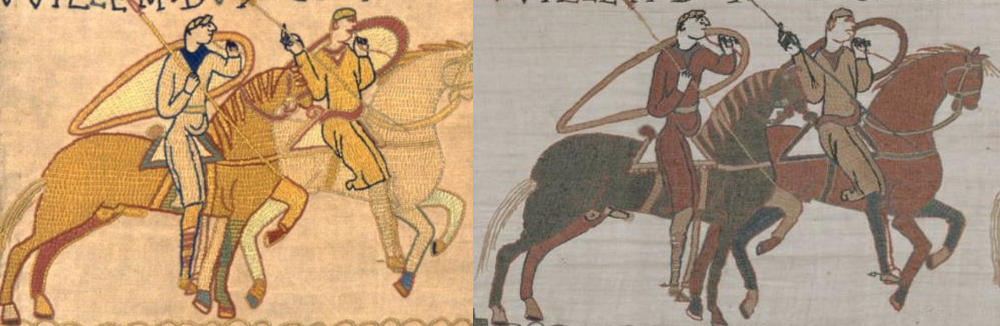
Soldiers on horse-back, the Reading Tapestry on the left and the original on the right (Ville de Bayeux, DRAC Normandie, Université de Caen Normandie, CNRS, Ensicaen, Clichés : 2017 – La Fabrique de patrimoines en Normandie)
In the borders there are several naked men but in the Reading tapestry this man's modesty has been protected with pants! This prudish addition was probably copied from ‘cleaned-up’ South Kensington Museum photograph.
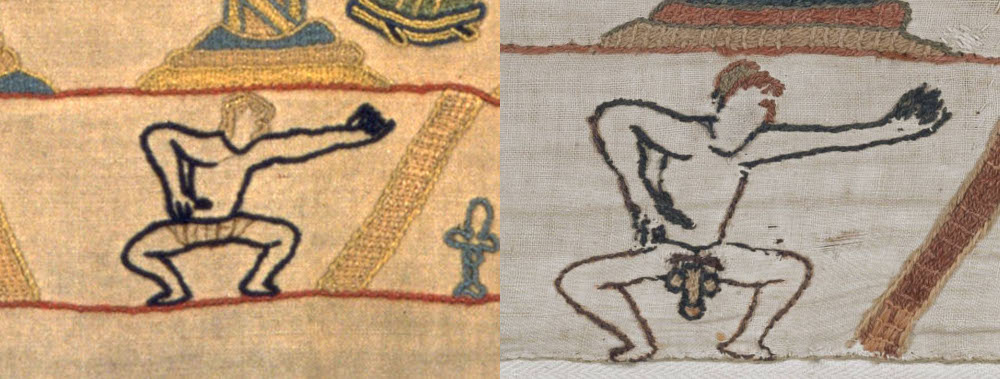
To the left is the man in the Reading tapestry and on the right is the original (Ville de Bayeux, DRAC Normandie, Université de Caen Normandie, CNRS, Ensicaen, Clichés : 2017 – La Fabrique de patrimoines en Normandie)
Some small details have been inaccurately reproduced in the Reading tapestry, mainly to figures in the borders. These were due to errors in the 1872 photographs, often where the detail was hidden behind the display case junctions.
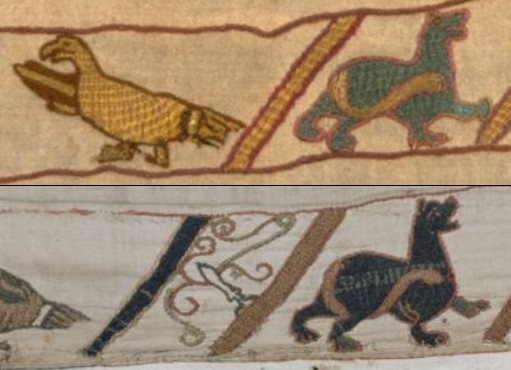
A small section of the border is missing on the Reading tapestry (top) when compared with the original (Ville de Bayeux, DRAC Normandie, Université de Caen Normandie, CNRS, Ensicaen, Clichés : 2017 – La Fabrique de patrimoines en Normandie)
And some 'mistakes' that aren't!
There are some details that look like reproduction errors, but they are faithful to the original tapestry.
These include off-set stitching between two adjacent strips on the original tapestry, Latin spelling mistakes and even the reproduction of old stains!
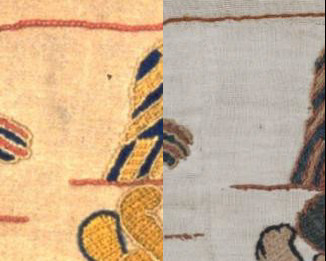
This shows how off-set stitching on the original tapestry was faithfully recreated on the Reading tapestry Ville de Bayeux, DRAC Normandie, Université de Caen Normandie, CNRS, Ensicaen, Clichés : 2017 – La Fabrique de patrimoines en Normandie)
Visit and find out more
If you visit the Reading Tapestry there is a more detailed gallery trail that compares the two tapestries, pick up a copy in the Bayeux Gallery.
Find out more about visiting on our Bayeux Gallery page
You can explore the Reading Tapestry scene by scene on our Britain's Bayeux Tapestry pages.
Credits
Thank you to Clémentine Paquier-Berthelot, Musée de la Tapisserie de Bayeux
Bayeux Tapestry Images: Ville de Bayeux, DRAC Normandie, Université de Caen Normandie, CNRS, Ensicaen, Clichés : 2017 – La Fabrique de patrimoines en Normandie
Reading Tapestry Images: Reading Museum (Reading Borough Council)